A Screenshot Is Not the Whole Story
A screenshot of online casino play shows a visible moment, not the whole story. Learn to describe its interface accurately and assess the caption’s claims.
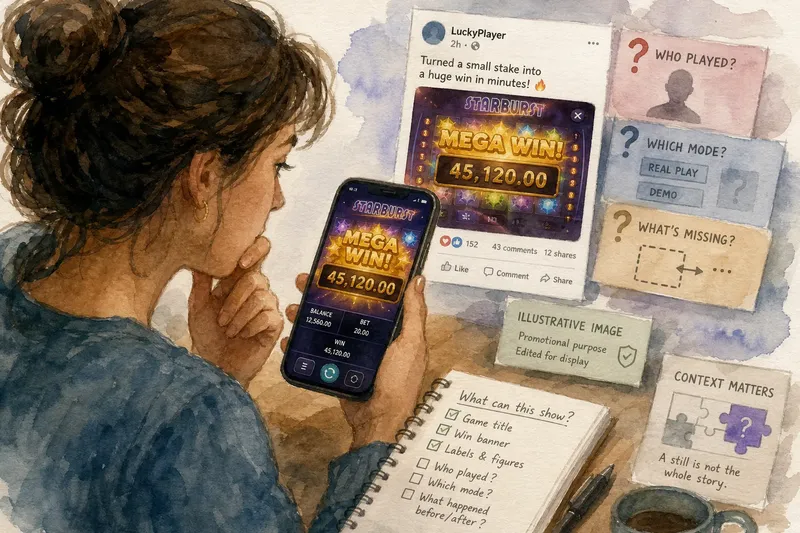
The most common mistake with an online casino screenshot is letting the caption supply a story the image cannot show. That can turn a promotional graphic into an assumed account of someone’s play, even though the frame offers no sequence or surrounding events.
Think of a screenshot as a page torn from a comic: it preserves one scene, but not what led to it or what follows. The useful question is not simply whether the image looks convincing, but what kind of claim it can support.
Describe the displayed scene
Say Mara sees a post in a gaming app’s social feed. It contains a colourful slot interface, a celebratory banner and a balance panel; the caption says a player “turned a small stake into a huge win in minutes”.
Mara can describe the game title if it is legible, the banner, and the labels and figures that are actually visible. She should phrase a number as something the screen presents, rather than as an independently confirmed account balance or payment.
That distinction is about describing the image’s content, not deciding whether it is genuine. A screenshot may be authentic and still leave important parts of its story unshown.
Check the image itself
Mara records concrete observations and lets each one shape what she says next. If a detail is missing or unclear, the decision is to withhold that interpretation or seek more context.
- Game identity: Check whether a title or provider name is readable and matches the caption. If it matches, describe the graphic as identifying that game; if it is absent or inconsistent, leave the identification unconfirmed.
- Game state: Check for labels or controls that distinguish a base game, bonus round or demo mode. If one is clear, describe the displayed state; if not, do not infer which mode was active.
- Figures and labels: Check whether a balance, stake or win figure has an adjacent readable label. If the label is clear, report what the display calls the figure; if it is cropped or ambiguous, do not assign it a meaning.
- Frame edges: Check whether the crop cuts off controls, account details or surrounding interface elements. If it does, name the missing context and avoid claims that depend on it; if it does not, describe only the additional elements that are visible.
- Caption scope: Check whether the wording describes the displayed moment or adds a duration, sequence or outcome. If it adds details beyond the frame, attribute them to the publisher; if it merely names visible content, keep the description limited to that content.
- Source and disclosure: Check for a named publisher and a notice that the image is promotional, illustrative or edited. If either is missing, keep the image’s status unresolved; if a disclosure is present, include it in the description.
- Date and version: Check for a date, platform or game-version label. If one is present, report it as supplied; if not, avoid presenting the interface as current or tied to a particular release.
The list does not turn a still into a record of a session. It helps Mara decide which details she can describe and which require another source.
Trace the caption’s claims
The phrase “in minutes” makes a claim about timing, while “small stake” implies a particular starting point. Neither is established by a still image unless the frame itself contains clear, relevant documentation—and even then, the source and meaning of that documentation matter.
Mara checks the surrounding post for its date, publisher, disclosure and a link to the original material. If those details are absent, she can still discuss the image’s design, but should not repeat the caption’s account as verified history.
Imagine Mara finds a second post from the same publisher that calls the graphic “illustrative”, while the first caption presents it as a player’s result. She notes the conflict, describes the image as a win-style screen, and asks the publisher to clarify its origin. The result is a more precise account: the graphic depicts a win, but its connection to an actual session is unresolved.
Questions about screenshots?
Can a screenshot prove a win?
It can show an interface presenting a win, but the still alone does not establish who played, which mode was active or what happened outside the frame. Describe the display without claiming that a player received the depicted result.
Can you tell if an image was edited?
Visible inconsistencies or a disclosure may raise questions, but a screenshot may not reveal whether it was altered. Check the original source and its surrounding context; if neither is available, say that the image’s history cannot be determined.
What can a crop hide?
A crop may remove labels, controls or clues to the game state. Note what is missing before interpreting a remaining figure or banner.
How should an unclear caption be quoted?
Attribute the wording to its publisher and identify it as a claim rather than a fact established by the image. If the distinction matters and you cannot find supporting material, leave the claim out.
Write the account carefully
Mara’s description can be brief and specific: the post contains a promotional image of a slot interface with a celebratory banner, and its caption claims a player won after a short session. The image does not verify the player, the session or the timing.
For anyone reading an online casino screenshot, a useful final check is to keep the screen’s contents separate from the caption’s narrative. That makes it possible to discuss the visual design and its persuasive effect without presenting an incomplete frame as a complete record.