The Interface Is Part of the Game: Reading an Online Table
Learn how to read an online table interface, compare its rules and format, and spot when a screen tells a story about play rather than chance.
The most common mistake when reading an online table interface is treating its layout as a neutral window onto the game. A prominent “continue” prompt can hurry you past a rule that changes how the table works, so start by asking what the screen is trying to make legible—and what it leaves for you to seek out.
Online tables borrow the visual language of physical rooms: a dealer’s space, a felt surface, chips, cards and a sense of being seated at a particular table. Those details help establish a scene, but the actual terms of play live in labels, rules and menus. Keep the stage separate from the instructions.
Separate scene and terms
A virtual table may look like a familiar casino table, a minimalist panel or a themed room. Treat the visual setting as atmosphere, not as a description of the game’s rules. The format name, rules and paytable tell you what kind of game is being presented.
Look for whether the table is described as live dealer, automated or another format. These labels explain how the game is presented and operated; they do not, by themselves, explain every rule. Open the information panel and read the specific wording attached to the table.
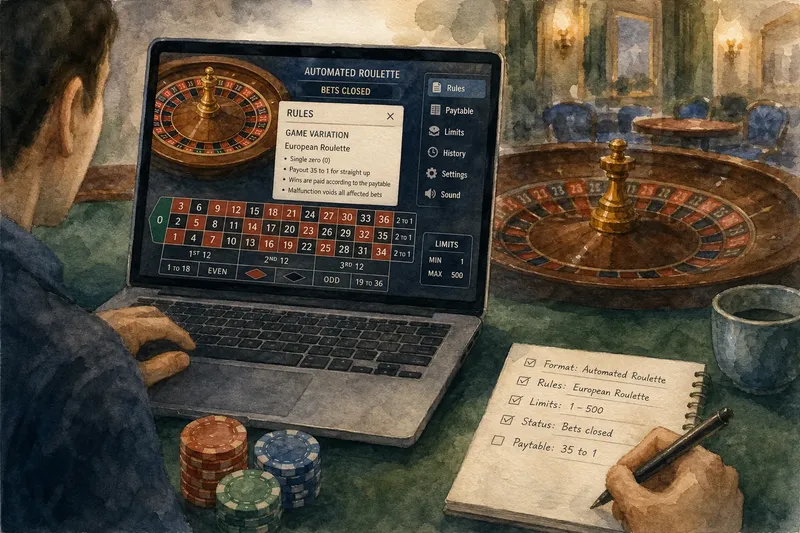
Imagine a fictional screen showing a polished roulette layout and a small “Rules” link. You open the link and find a rule variation named there, then compare that wording with the format label before deciding whether the table is clear enough for you. The result is a more accurate description of what the screen offers, not a prediction about a spin.
Read the table’s vocabulary
Casino interfaces often use short labels that assume a player already knows the format. “Dealer,” “round,” “side bet” or “payout” may have a specific meaning in context, so consult the table’s own help text rather than relying on a label alone.
Notice which terms describe a game rule and which describe a platform action. “Rules” and “paytable” usually point towards game information; “sound,” “history” or “settings” may refer to display or navigation. If a term remains vague after opening its help panel, leave it unresolved rather than supplying your own definition.
This is a little like reading a theatre programme beside a stage set: the scenery suggests a place, while the programme explains what is being presented. Neither should be mistaken for evidence about what happens next.
Track the story of a round
Animations and status messages shape how a round feels. A countdown, a dealer gesture or a celebratory effect can make events seem dramatic, but each is part of the interface’s presentation. Read the status text to understand what action the game says has occurred.
When the screen changes, identify the change in plain terms: a selection appeared, a panel closed, or the display moved to another stage. Then check whether the rules or current selection changed too. This keeps the story told by the animation distinct from the information provided by the game.
Compare the format, not the staging
When looking at two tables, compare equivalent information rather than choosing by theme or visual polish. One may show its rules immediately while another places them behind a menu; that is a difference in access, not proof that either table is better.
- Check whether the game format is named; if it is, compare the wording with the rules, and if it is not, open the information panel or regard the format as unclear.
- Check whether a live dealer or automated presentation is identified; if it is, use that label to understand the format, and if it is not, consult help rather than infer it from graphics.
- Check whether the rules and paytable are readable; if they are, review the terms, and if they are not, expand the panel or choose a view where the wording is legible.
- Check whether table limits and conditions are stated; if they are, note what the screen says, and if they are not, do not assume the missing terms.
- Check whether a status message describes the current stage; if it does, use it to interpret the screen, and if it does not, open help or pause before acting.
- Check whether the table’s information panel can be reopened; if it can, return to it when a term is unclear, and if it cannot, treat the details as difficult to verify.
These checks help distinguish a convenient presentation from a clear account of the game. If a detail is missing, mark it as unknown; a convincing theme cannot fill that gap.
Questions about table formats?
What does live dealer mean?
It identifies a format in which a human dealer is presented as part of the game experience. Read the table’s own description for details about how that particular format works.
Are themed tables different games?
A theme may change the artwork, sounds or setting without changing the underlying format. Compare the game name and written rules rather than judging by the room or graphics.
What is a paytable for?
A paytable sets out how the game describes payouts for specified outcomes or choices. Read it alongside the rules, since the paytable alone may not explain how a round is played.
Can an animation indicate a likely result?
An animation shows the interface’s presentation of an event, not reliable information about a future outcome. Use written rules to understand the game’s terms and keep visual effects separate from claims about chance.
Follow one screen
Say you encounter an invented table screen labelled “automated roulette”. The rules link lists a variation, the limits appear in a separate panel, and the round status says “bets closed”. You open the rules, note the named variation, check the limits, then return and confirm the status; the resulting picture is that you know which format and terms the screen describes, while the next outcome remains unknown.
If the status and the rules appear to conflict, check whether you have opened a different table or view. If the wording still does not make sense, stop short of guessing and seek clearer platform help.
Choose clarity over theatre
A useful online table interface lets you tell the game’s format, rules and current stage apart from its decorative setting. That distinction makes comparison more grounded: you can decide whether the terms are understandable without treating presentation as a clue to chance.
When searching for how to read an online table interface, focus on the words that define play and the format that frames it. The most useful screen is not necessarily the most vivid one; it is the one whose stated terms you can locate, interpret and revisit.